
LCOE as member of AELP attends the 72nd Technical Committee of STL hosted by SATS in Borlänge (Sweden)
14 noviembre 2025
LCOE Restores Its Historic Sphere Gap at the High Voltage Technology Center
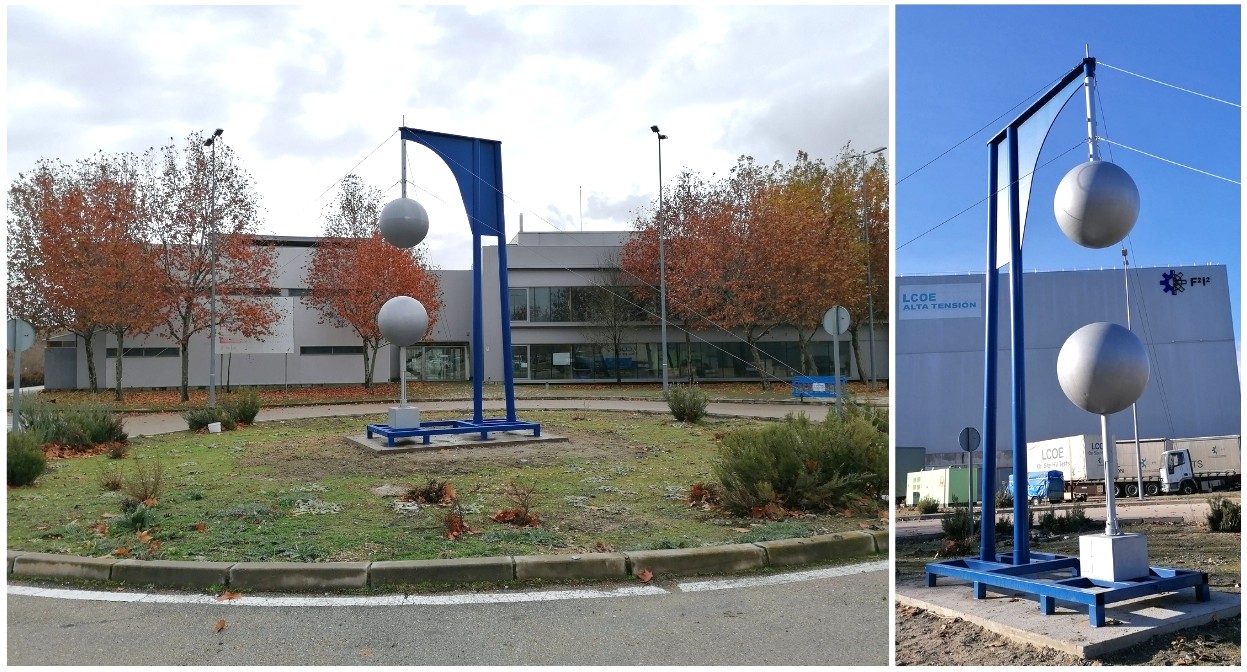
The LCOE High Voltage Technology Center has restored the laboratory’s historic sphere gap, a symbol of LCOE’s long-standing tradition in high-voltage testing and measurement over more than 75 years of activity.
This unique piece, representing the history of high-voltage metrology, has been installed in a prominent and accessible location at the Tecnogetafe facilities: the interior roundabout at the entrance to the LCOE high-voltage laboratory.
Origins of the Sphere Gap
The earliest documented use of sphere gaps, or spark gaps formed by spherical electrodes, dates to 1837. In his work “Experimental Researches in Electricity”, Michael Faraday used spheres of different sizes to study how conductor geometry influenced electrical discharges.
His experiments demonstrated that air behaves as an insulator that breaks down under a certain electrical stress, laying the theoretical foundations for the later use of sphere spacing as a method for measuring high voltages.
In 1883, James Wimshurst made a significant contribution with the invention of a high-voltage electrostatic generator incorporating sphere gaps, where spark length provided a practical estimation of voltage (approximately 30 kV per centimeter of air).
Role in Scientific and Industrial Development
From the late 19th century onward, sphere gaps became essential components in physics laboratories. They played a key role in Heinrich Hertz’s experiments in 1887 demonstrating electromagnetic waves, as well as in Nikola Tesla’s pioneering work with transformers and power switching devices.
At the turn of the 20th century, the expansion of electrical transmission networks created the need to measure voltages of hundreds of kilovolts. Conventional voltmeters were unable to reach such levels, leading to the widespread adoption of sphere gaps capable of generating a uniform and mathematically predictable electric field.
Under standardized atmospheric conditions (20 °C and 101.3 kPa), this method allowed peak voltages to be determined with an uncertainty of less than 3 %.
Standardization and IEC 60052
In the early 20th century, Frank W. Peek, an engineer and researcher at General Electric, conducted extensive studies on the relationship between sphere separation and peak breakdown voltage.
Based on his work, the International Electrotechnical Commission (IEC) adopted Peek’s tables to develop the international standard IEC 52, now known as IEC 60052. First published in 1935, this standard laid the foundations for the standardized use of sphere gaps in high-voltage measurement.
Operating Principle
The operating principle of a sphere gap is based on the creation of a uniform electric field between two spherical electrodes. In such conditions, the dielectric strength of air is approximately 30 kV/cm.
One electrode is connected to ground, and the separation is adjustable up to a maximum of half the sphere diameter. Beyond this limit, field uniformity is lost and measurement accuracy decreases.
- 100 mm spheres: measurements up to 100 kV
- 1000 mm spheres: measurements up to 1000 kV
The Tecnogetafe Sphere Gap
The sphere gap installed at Tecnogetafe consists of two metallic spheres with a diameter of one meter, enabling peak voltage measurements of up to 1 MV.
Used by LCOE since 1950, it supported measurements, tests, studies, and experimental work at power frequency and lightning impulse voltages, playing a fundamental role in the development of international high-voltage testing standards.
Current Relevance
Today, sphere gaps remain of interest in high-voltage laboratories, particularly in impulse voltage generators and triggering systems for high-current generators.
However, their role as a primary measurement system has largely been replaced by voltage dividers and digital recording systems, which offer lower uncertainties and faster, more reliable results.
For more information:
Tomás García
Director, LCOE High Voltage Technology Center and Metrology
tgarcia@ffii.es


